
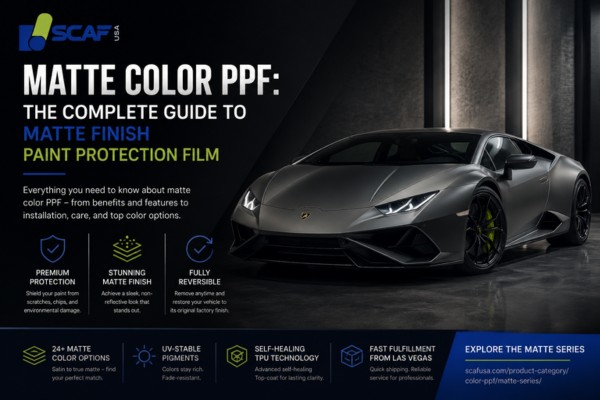
Matte Color PPF Guide | Installation & Maintenance Tips
The automotive world has witnessed a quiet revolution over the last decade. Where high-gloss paint once ruled as the undisputed king of showroom floors, a new aesthetic has taken over garages, car shows, and Instagram feeds: the deep, light-absorbing elegance of matte color PPF. If you have ever seen a blacked-out luxury SUV or a silky-smooth sports car wearing a finish that seems to swallow light rather than reflect it, you have almost certainly been looking at matte color paint protection film in action. At SCAF USA, we specialize in premium color PPF technologies engineered for both everyday drivers and serious enthusiasts. Our Matte Series offers over 24 individual colorways ranging from Frozen Leaden Gray to Capri Gray Purple, each designed to deliver that signature non-reflective finish while providing the structural protection your paint deserves. In this comprehensive guide, we cover what matte color PPF actually is, how it differs from satin color PPF, why it outperforms traditional vinyl wraps, and everything you need to know before making your investment. What Is Matte Color PPF? Matte color PPF, short for matte color paint protection film, is a thermoplastic urethane (TPU) film that is pigmented throughout and engineered with a flat, low-gloss top layer. Unlike traditional clear PPF, which is transparent and designed only to protect the factory paint beneath it, this protective film serves a dual purpose: it changes the color and finish of your vehicle while simultaneously acting as a physical barrier against chips, scratches, UV radiation, and environmental contaminants. The “matte” designation refers to the light reflectance value of the film’s surface. A standard gloss film will typically measure above 80 GU (gloss units) at a 60-degree angle. A true matte film sits below 30 GU, creating that soft, diffused surface that absorbs rather than bounces ambient light. The result is a three-dimensional, almost tactile appearance that photographs beautifully and turns heads in real life. According to the Wikipedia overview of paint protection film, the material was originally developed for military use to protect helicopter rotor blades from high-speed particle damage. Automotive applications followed, and today’s color PPF products have evolved far beyond that original utilitarian purpose into genuine styling tools with industry-leading protection specs. What sets modern matte color PPF apart from earlier generations of the product is the inclusion of self-healing top coats. Many of today’s premium matte films contain elastomeric polymers in the clearcoat layer that allow light surface scratches to disappear when heat is applied, either from the sun or a heat gun, without compromising the matte appearance. This self-healing capability was once exclusive to gloss films, but now extends fully to the matte product category. Matte Color PPF vs. Satin Color PPF One of the most common points of confusion for car owners entering the world of color PPF is the distinction between matte and satin color PPF. While both finishes occupy the “non-gloss” spectrum and share many of the same protective properties, they produce noticeably different visual results and suit different aesthetic preferences. Satin color PPF sits in the middle of the gloss scale, generally in the 30–60 GU range, producing a smooth, semi-sheen surface that is sometimes described as “eggshell” or “silk.” It is shinier than true matte but nowhere near the mirror-like depth of a gloss film. Satin finishes tend to emphasize the body lines and curves of a vehicle in a particularly flattering way, creating a sense of sleekness that can make a car look factory-fresh and intentionally designed rather than wrapped. True matte finish PPF, by contrast, operates at the lower end of the reflectance scale and produces a heavier, more opaque appearance. Where satin looks refined and modern, pure matte reads as bold and aggressive. Matte black, for instance, is practically synonymous with stealth aesthetics; matte military green evokes rugged, off-road authority; matte frost white delivers a futuristic minimalism that standard gloss white cannot touch. From a maintenance perspective, matte and satin color PPF share similar care requirements. Both should be cleaned with pH-neutral products and should not be waxed with conventional carnauba or synthetic waxes, which can fill in the microscopic peaks and valleys of the surface that create the non-reflective effect. Both finishes are also incompatible with machine polishing unless the owner is specifically trying to transition the vehicle back to a glossier appearance. This care requirement is far less stringent than maintaining a matte factory paint job, however, because the PPF itself acts as the sacrificial layer, keeping your factory paint fully fully sealed and protected beneath it at all times. At SCAF USA, our full Color PPF collection includes both pure matte and satin-adjacent options so you can choose exactly the reflectance level that matches your vision. Why Choose Matte Color PPF Over Vinyl Wrap? The conversation about this protective film almost always circles back to the comparison with matte vinyl wrap, since both products can produce a visually similar result at first glance. But the differences in material composition, durability, and protection level are significant enough to justify the price premium that PPF commands. Vinyl wrap is made from PVC (polyvinyl chloride) film with a pigmented top layer and pressure-sensitive adhesive. It is designed primarily as a cosmetic product. Its core function is aesthetics, and while it does offer some minor protection against door dings and light abrasion, it cannot absorb the kind of road debris impact that a thicker TPU film can. Most vinyl wraps range from 2–4 mils in thickness. Premium color PPF products, including the SCAF USA Matte Series, are manufactured at 6–8 mils, a meaningful difference when a gravel chip at highway speed is the thing standing between the film and your factory paint. TPU, the material at the heart of all quality matte color PPF, is fundamentally more elastic and impact-absorbent than PVC. When a stone strikes a TPU film, the material deforms to absorb the energy and then returns toward its original shape rather than cracking or delaminating. This elastic memory, combined with the self-healing properties mentioned earlier, makes TPU-based color PPF a genuinely protective product
Matte Color PPF Guide | Installation & Maintenance Tips Read More »